
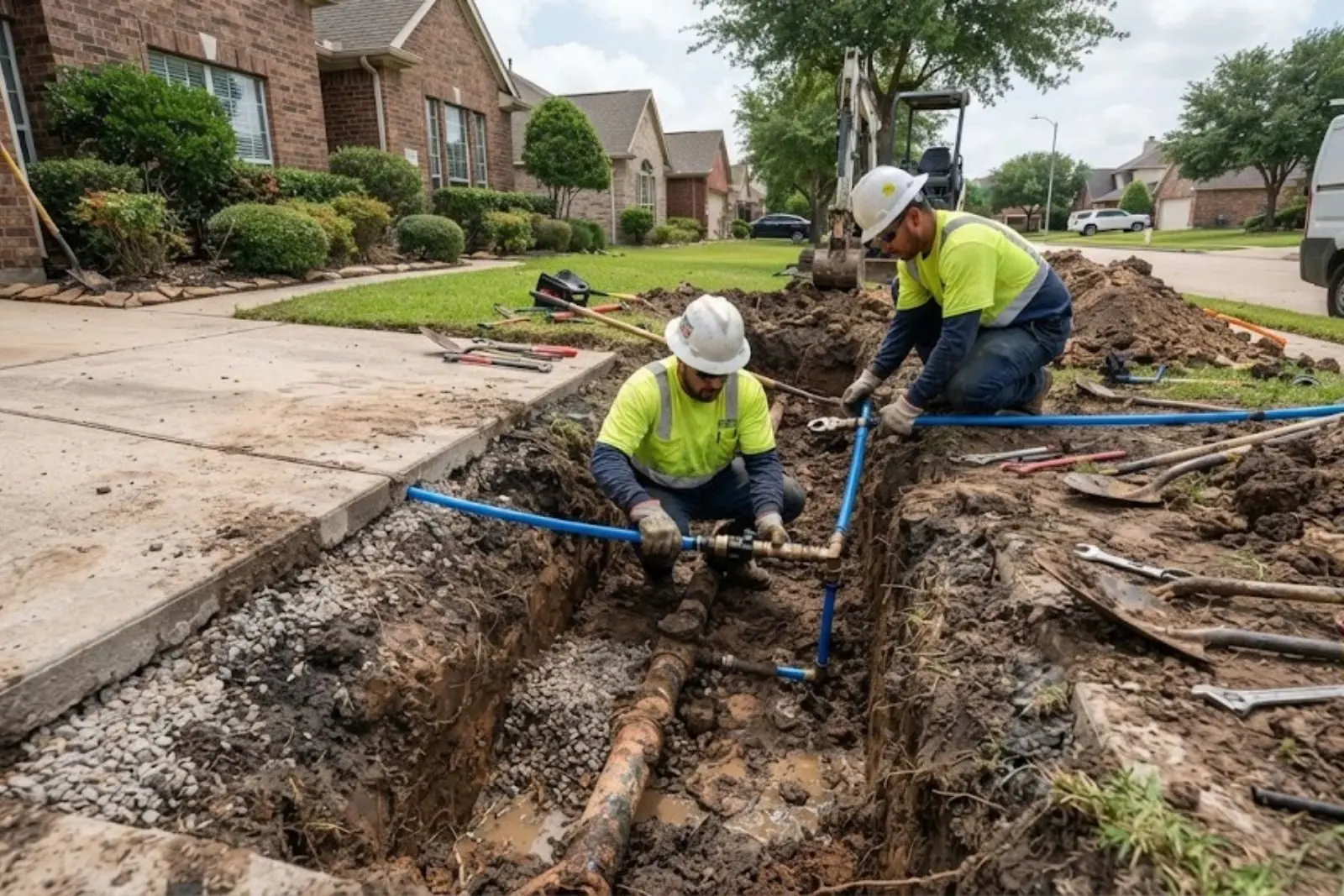
You can often tell there is a leak in your yard without digging. A patch of lawn that stays soggy in dry weather, a sunken strip of ground, water pooling near the foundation, or a bill that rose without a change in use are all signs.
The fastest confirmation is the meter test below. Once you know a leak exists, you narrow down whether it sits in the buried service line, the irrigation system or an outdoor fixture.
Step one: the meter test
Turn everything off
Close every tap, stop the ice maker and turn off the irrigation controller.
Read the meter
Lift the meter box lid, find the leak indicator or the dial, and write down the reading.
Wait an hour
Use no water for an hour, then read the meter again.
Compare
If the reading changed, or the indicator spins, water is leaking somewhere.
If the meter moves, close the main valve at the house and check again. A meter that stops means the leak is inside the house or on the house side of the valve. A meter that keeps turning means the leak is between the meter and the valve, which is the buried service line.
Clues in the yard
| Clue | Likely source | Next step |
|---|---|---|
| Soggy patch along a straight line from the meter to the house | Buried service line | Call a plumber for leak location |
| Wet ground around a sprinkler valve box | Irrigation valve or line | Check the box, shut off irrigation |
| Water at a hose bib or near an outside wall | Hose bib or supply line | Turn off the hose bib shutoff, inspect |
| Unusually green strip of grass | A slow leak feeding the lawn | Meter test, then locate |
| Sunken or cracked paving | Washed-out soil from a long leak | Call for a leak location |
| Pressure dropped everywhere | Large leak in the service line | Close the main and call |
What not to do
Mistakes that make a leak worse
- Do not dig randomly. A buried line can cross other utilities.
- Call 811 before any digging, so buried lines are marked.
- Do not ignore a small, steady leak. It washes out soil and grows.
- Do not assume a wet spot is a sprinkler issue without testing the irrigation.
- Do not wait for the next bill to confirm. Do the meter test now.
Finding the exact spot
Locating a buried leak takes tools. An acoustic listening device picks up the sound of escaping water along the pipe, and line tracing shows the path of the pipe so the plumber knows where to listen. Thermal imaging helps if a hot water line is involved.
A good plumber marks the spot before digging, which means a small hole in the lawn and not a trench. Our leak detection page explains the process in more detail.
Once the leak is found, the repair depends on the pipe and the depth. A spot repair is the cheapest, and a long line with several leaks may justify replacement, which our water line repair page covers. If water is surfacing and you cannot control it, close the main valve and call our 24/7 line.
Irrigation leaks
Sprinkler systems leak at fittings, valves and heads, and the leak shows as wet ground or a zone that runs forever. Turn off the irrigation controller and repeat the meter test. If the meter stops, the leak is in the irrigation system. Check valve boxes for standing water. Irrigation repair may belong to a landscape contractor, and we will tell you if it does.
How a small leak turns into a big bill
A pinhole in a buried line at normal house pressure can pass a surprising amount of water over a month, and none of it shows if the soil drains well. Because the meter keeps counting, the cost arrives on the bill long before any wet patch does. That is why the meter test is worth repeating every season, and why a bill that climbs for two cycles in a row deserves a closer look.
If you find a leak and plan to repair it yourself, remember that the line is under pressure, that it may be near gas, electric or communications lines, and that a cut in the wrong place can flood the hole. Marking utilities first and shutting off the main before digging are the minimum. Many homeowners find that having the location confirmed and the repair done by a plumber costs less than a mistake.
Repairing a buried supply line is permitted plumbing work under the Uniform Plumbing Code (UPC) as adopted in Washington, and you should call 811 before digging so buried utilities are marked.
Kirkland note: who owns what, and who to call
The City of Kirkland buys its water from Seattle Public Utilities through the Cascade Water Alliance and distributes it through its own system. In general, the pipe from the meter to your house is the owner's. The City's Water Division lists (425) 587-3900 for emergencies and (425) 587-3150 for utility billing, and the water conservation line is (425) 587-3907.
Parts of north Kirkland are served by Northshore Utility District or Woodinville Water District, so call the district that serves your street.
Hose bibs and backflow prevention devices appear on the permit-required list for Kirkland in the regional permit table, so ask the City before replacing one. If you live in Redmond, the City of Redmond runs its own water system, and our Redmond page explains how we serve that area.
Yard leak questions
Turn off all water, read the meter, wait an hour with no use, then read it again. A changed reading means a leak.
In general, the owner is responsible for the line from the meter to the house. Call the City or your utility district to confirm where responsibility starts.
Yes. Buried leaks may never surface, and the meter and the bill still show the loss.
Call 811 before any digging. Checking the meter does not need it.
You can confirm one with the meter test. Locating the exact spot usually takes listening tools.