
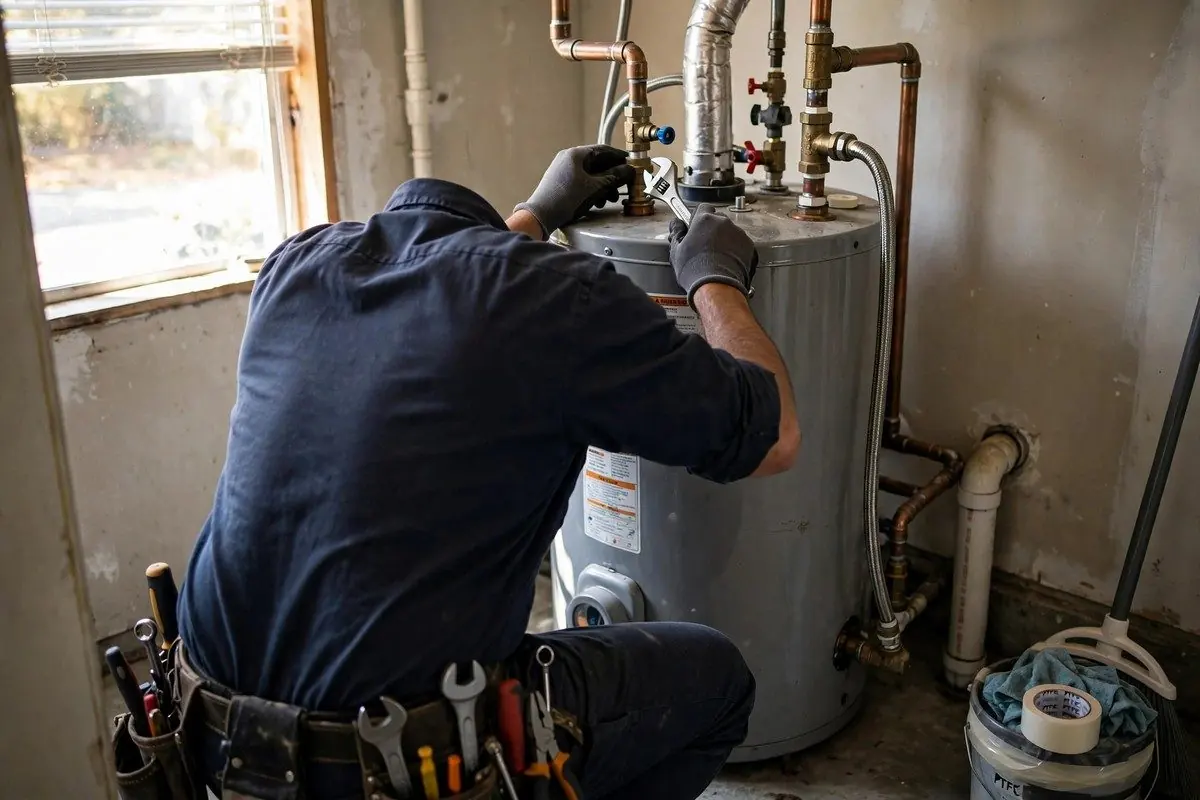
A water heater that stops working rarely picks a convenient hour. If the tank is leaking, shut off the cold water supply valve on top of the heater, turn off the power at the breaker for an electric unit or set a gas unit to pilot, and call our 24/7 emergency line.
If the problem is only no hot water, you have a little more time, but the cause matters, so it is worth a call.
Start with the symptom
| Symptom | Common causes | Repair or replace? | |
|---|---|---|---|
| callout | If you smell gas | Leave the house, do not flip switches, and call Puget Sound Energy at 1-888-225-5773 or 911 from outside. Call us afterward for the repair. A gas smell is never a plumbing appointment first. | warn |
| No hot water at all | Tripped breaker or failed heating element (electric), pilot out, thermocouple or igniter fault (gas) | Usually repair | |
| Water warm but never hot | Failed lower element, sediment buildup, thermostat set low | Usually repair | |
| Water pooling at the base | Leaking tank, loose fitting, failed relief valve | Fitting or valve: repair. Tank: replace | |
| Rumbling or popping | Sediment hardened at the bottom of the tank | Flush may help, older tanks may not recover | |
| Rust-colored hot water only | Corroded tank interior or spent anode rod | Often replace if the tank is older | |
| Water drips from the relief valve pipe | Failed relief valve or pressure from a closed system | Repair, and check pressure |
Leaks: finding where the water really comes from
Not every wet floor means a dead tank. The cold and hot connections on top, the drain valve at the bottom, the temperature and pressure relief valve and the pipe it feeds all drip before the tank does. A plumber traces the water upward to its source.
If the tank shell itself is leaking, a repair is not possible, and the honest advice is replacement. If a fitting or valve is the source, the fix is often quick and the heater keeps running.
Water from the relief valve discharge pipe deserves attention. That valve is a safety device, so do not cap it or plug it. A weeping valve can mean thermal expansion on a closed system or simply a worn valve, and a plumber can tell which by checking incoming water pressure and whether an expansion tank is present.
No hot water: gas and electric each fail in their own way
On an electric heater, a tripped breaker or a burned-out element are the usual culprits. Upper and lower elements fail separately, which is why some tanks give a short burst of hot water and then go cold. On a gas heater, a pilot that will not stay lit often points to a worn thermocouple, and a modern unit that will not ignite may have a failed igniter or flame sensor.
Both are small parts compared with the cost of a new tank.
Hybrid and power-vent models add a blower, a condensate drain and electronics. Those units need a plumber who has seen the model before, and we will tell you on the phone if yours is outside what a quick repair can solve. Where a part is no longer available, a repair can end up costing more than it is worth.
Kirkland-specific details that affect your heater
Kirkland buys its water from Seattle Public Utilities through the Cascade Water Alliance, and the City reports total hardness of 1.43 grains per gallon. That is very soft water, so heavy limescale is less of a driver here than in hard-water regions, though sediment from the pipes still settles in a tank over the years. Older tanks fail from corrosion more often than from scale.
Washington's plumbing code, WAC 51-56, requires water heaters to be braced against earthquake movement, so a tank that stands loose in a garage or closet is worth correcting during any visit. In Kirkland, replacing a water heater is on the permit-required list published by the regional permit offices, which is one more reason a licensed plumber is the right call for a swap.
Repairs to parts on the existing unit are different, and we will tell you if a permit applies.
Before the plumber arrives
- Shut off the cold water supply to the heater at the valve on top, if the tank is leaking.
- Switch off the breaker for an electric heater, or turn a gas control to pilot.
- Keep towels or a wet vacuum around the base and clear anything stored on the floor nearby.
- Take a photo of the data plate with the model and serial number if you can reach it safely.
- Do not touch wiring or relight a gas pilot if the area is wet or you smell gas.
When repair stops making sense
Repair is the right answer when a single part has failed and the tank is in sound condition. It stops being the right answer when the tank itself leaks, when the unit is well past its expected life and needs a second major part, or when rust shows at the connections.
Ask your plumber for the data plate age and compare it with the repair estimate. If a full swap makes more sense, our water heater replacement page explains what that visit involves, and homeowners who prefer on-demand hot water can look at tankless options.
Pricing factors and insurance
- Gas or electric, and the age and model of the unit.
- Whether the part is on the truck or has to be ordered.
- Access to the heater: a closet or a tight crawlspace takes longer than a garage wall.
- After-hours work compared with a daytime visit.
- Whether code work such as bracing or a new relief valve line is needed.
You will hear a clear price before work starts. Many homeowner policies cover sudden water damage from a failed tank and not the tank itself, so photograph the area and talk with your insurer. If you want a number for your exact heater, call us and we will ask the questions that shape it.
Repairs to a gas heater touch the gas supply, the vent and the relief valve, which the Uniform Plumbing Code (UPC) as adopted in Washington regulates. A replacement part should match the unit's listing, and a discharge pipe from the relief valve is a safety item that should not be capped.
Water heater questions from Kirkland homeowners
Yes. The line is open 24/7. If your tank is leaking, shut off the cold supply and the power or gas, then call. We dispatch a plumber as soon as one is available and tell you plainly what to expect.
Tank units commonly last around a decade or more, depending on use and maintenance. The data plate has a serial number that usually encodes the date, and a plumber can read it for you.
Policies differ. Many cover sudden water damage from a failure and exclude the heater itself. Photograph everything and ask your insurer before cleanup.
Yes. Error codes, scale and ignition faults are common, and flushing is a regular maintenance task. See our tankless water heater page for flush and descale details.
A failed lower element on an electric tank, a thick layer of sediment, or a broken dip tube are common causes. A plumber can test the elements and check the tank.
Washington's plumbing code, WAC 51-56, requires water heaters to be braced. If yours stands loose, a plumber can add straps during any visit.