
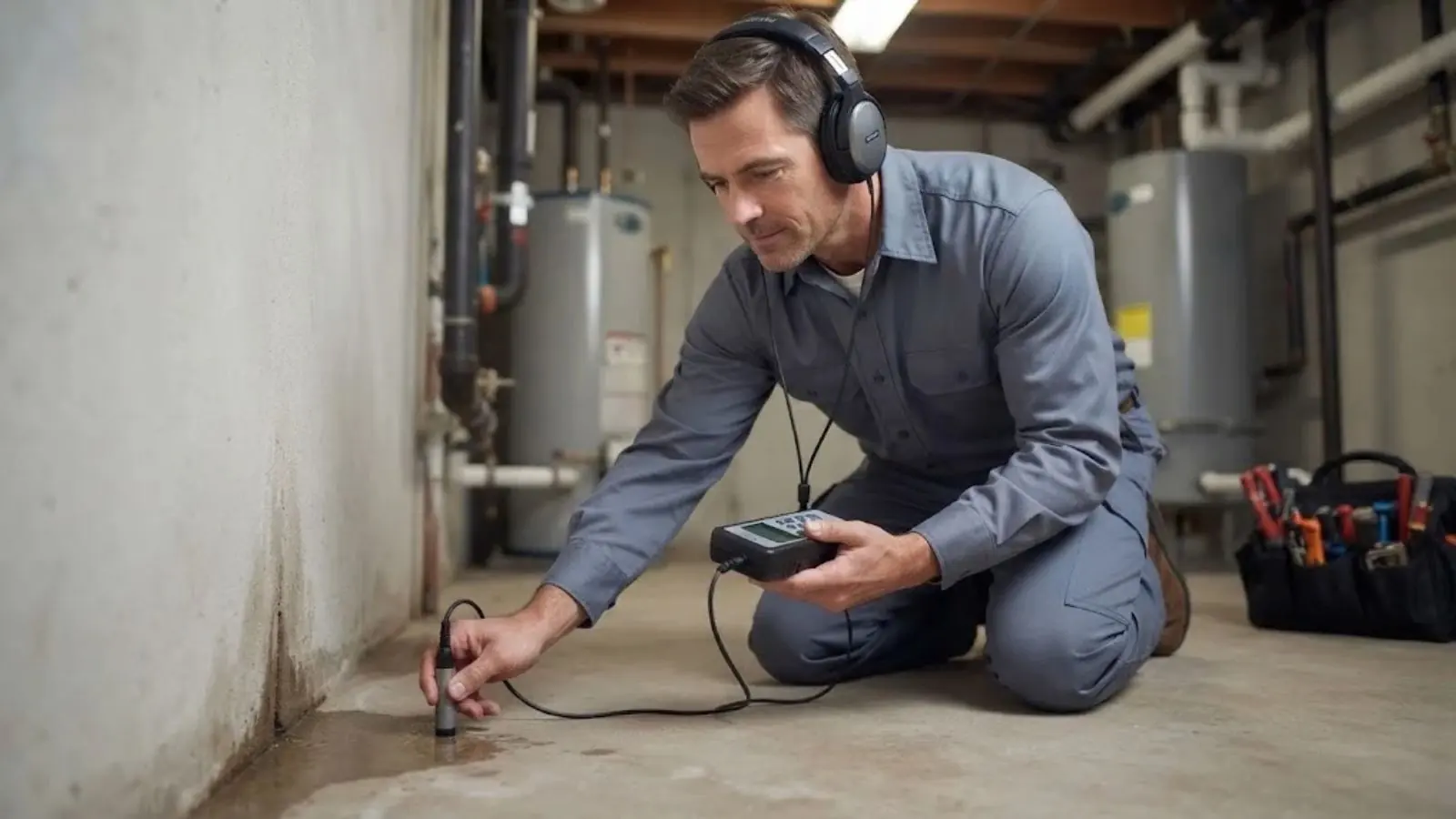
Most hidden leaks start as a symptom, not as a puddle. A higher bill, a meter that moves when nobody is home, a hot spot under bare feet, the sound of water in a quiet wall, or a stain on the ceiling that was not there last week. Any of those is a reason to call. If water is actively flowing into the house, shut off the main valve and use our 24/7 emergency line.
Start with the meter test
You can do a first check without a plumber. Turn off every fixture, the ice maker and the irrigation, then look at the leak indicator on your water meter. Many meters have a small triangle or dial that spins when any water moves. If it turns with everything off, water is leaking somewhere between the meter and your fixtures. Write down the reading, wait an hour without using water, and read it again.
If the reading changed, you have a leak and the next question is where. Close the main valve to the house and watch the meter again. If it stops, the leak is inside the house or on the house side of the line. If it keeps moving with the main closed, the leak is outside or the valve is failing.
High water bill: what it usually means
A running toilet is the most common cause, and the cheapest to fix. After that come dripping faucets, a leaking water heater connection, an irrigation line broken by roots or a mower, and an underground service line leak. The City of Kirkland handles utility billing at (425) 587-3150, and its water conservation line at (425) 587-3907 can help you read a meter or understand a bill.
Our job is to find the source of the extra water.
| Symptom | Likely area | Method |
|---|---|---|
| Meter moves with fixtures off | Service line or house piping | Isolate with shutoffs, then acoustic listening |
| Warm spot on a floor or hot water seems slow | Hot line under a slab or in a crawlspace | Thermal imaging and acoustic listening |
| Stain on ceiling or wall | Supply or drain line overhead, or a fixture above | Moisture meter, then opening a small access |
| Wet crawlspace or damp insulation | Supply or drain line under the house | Visual check and pressure test |
| Soggy patch in the yard, no rain | Buried service line or irrigation line | Acoustic listening and line tracing |
| Running toilet sound | Flapper or fill valve | Dye test, then toilet repair |
How we find a leak without tearing up the house
Good leak detection uses tools in a sensible order. A pressure test tells us whether a line holds. An acoustic listening device picks up the sound of escaping water through floors and walls, and a thermal camera shows temperature differences that mark hot water lines. A moisture meter confirms damp drywall. Together these let a plumber open the smallest possible access to repair the pipe.
We will tell you honestly what we find and what we do not. Some leaks are certain. Some are probable, and the next step is a small test cut. We would rather say that than guess and open a wall in the wrong place.
Ceiling and wall leaks
A stain on a ceiling is often a symptom with a source one room away. Water follows joists and pipes before it shows. The first step is to shut off the supply to any fixture above the stain, then see whether the stain stops growing.
Do not poke a bulging ceiling without a bucket underneath, because it can release a lot of water at once. A plumber can confirm whether the source is a supply line, a drain, an upstairs shower pan, or the roof, which is a different trade.
Under-house and crawlspace leaks
Many Eastside homes in Juanita, Finn Hill and Kingsgate sit over crawlspaces or partial basements, which means a pipe leak can drip for months before anyone sees damp insulation or smells mildew. A quick look with a flashlight is a start. Wet soil, sagging insulation, or dripping from a hanging line are the clues. Because moisture invites mold and rot, do not wait for an obvious puddle.
Slab leaks and buried lines
In homes with concrete slab floors, a leak in a pipe under the slab shows up as a warm spot, a bill spike, or the sound of running water when everything is off. Slab leaks need careful diagnosis before anything is cut.
Options include repairing the pipe through a tunnel or an access cut, rerouting the line through walls, or repiping. See repiping if the plumbing is old enough that one leak is likely to be followed by another.
A buried line leak between the meter and the house is its own problem. Wet ground without rain, a drop in water pressure, or an unusually green strip of lawn can point to it. The private line from the meter belongs to the owner, which makes accurate location valuable, and a water service line repair may follow.
Yard, irrigation and spa leaks
Irrigation systems leak quietly under the lawn, often at a fitting or valve box, and a sprinkler zone that runs longer than it should can double a summer bill. Check the valve boxes for standing water. Pool and spa leaks are a separate job, and we will tell you if the problem is outside our scope.
Quick checks before you call
- Read the meter, wait an hour with no water used, and read it again.
- Listen at the water heater, under sinks and at the toilet for hissing or dripping.
- Drop a few drops of food coloring in each toilet tank and look in the bowl after twenty minutes.
- Look for damp cabinets, discolored baseboards, a musty smell, or peeling paint.
- Note when the high bill first appeared, because the date helps narrow the cause.
Pricing factors
- Size of the home and how many areas need testing.
- Tools needed: pressure testing, acoustic or thermal.
- Whether the leak is accessible or needs a test cut.
- After-hours dispatch compared with a scheduled visit.
- The repair that follows, which is priced separately once the source is known.
You will get a clear price before work starts. Many homeowner policies cover sudden water damage and some cover the cost of locating a leak, but terms differ, so call your insurer. If you want to talk it through, call us and describe your symptom.
Washington's plumbing code, WAC 51-56, adopts the Uniform Plumbing Code (UPC) with state amendments. Locating a leak is the first step. A repair to the pipe that leaks must meet that code, and a leak in a wall or under a slab may involve opening the finish, which is worth discussing with your insurer first.
Leak detection questions from Kirkland homeowners
Yes. The line is open 24/7. If water is flowing, shut off the main valve first. We send a plumber as soon as one is available.
Common signs are a warm patch on the floor, a water bill that rose without explanation, the sound of running water with all fixtures off, and a meter that keeps turning. A plumber confirms with listening tools and pressure tests.
Check the toilets with dye, look for dripping fixtures, and do the meter test. If the meter still turns with everything off, call a plumber.
Often yes, because acoustic and thermal tools narrow the location. We still open access for the repair, but it is as small as possible.
Yes. You get a separate clear price for the repair before it starts, and you decide whether to go ahead.
Sometimes. We can find leaks in the supply to the system. Sprinkler head and zone issues may belong to a landscape or irrigation contractor.