
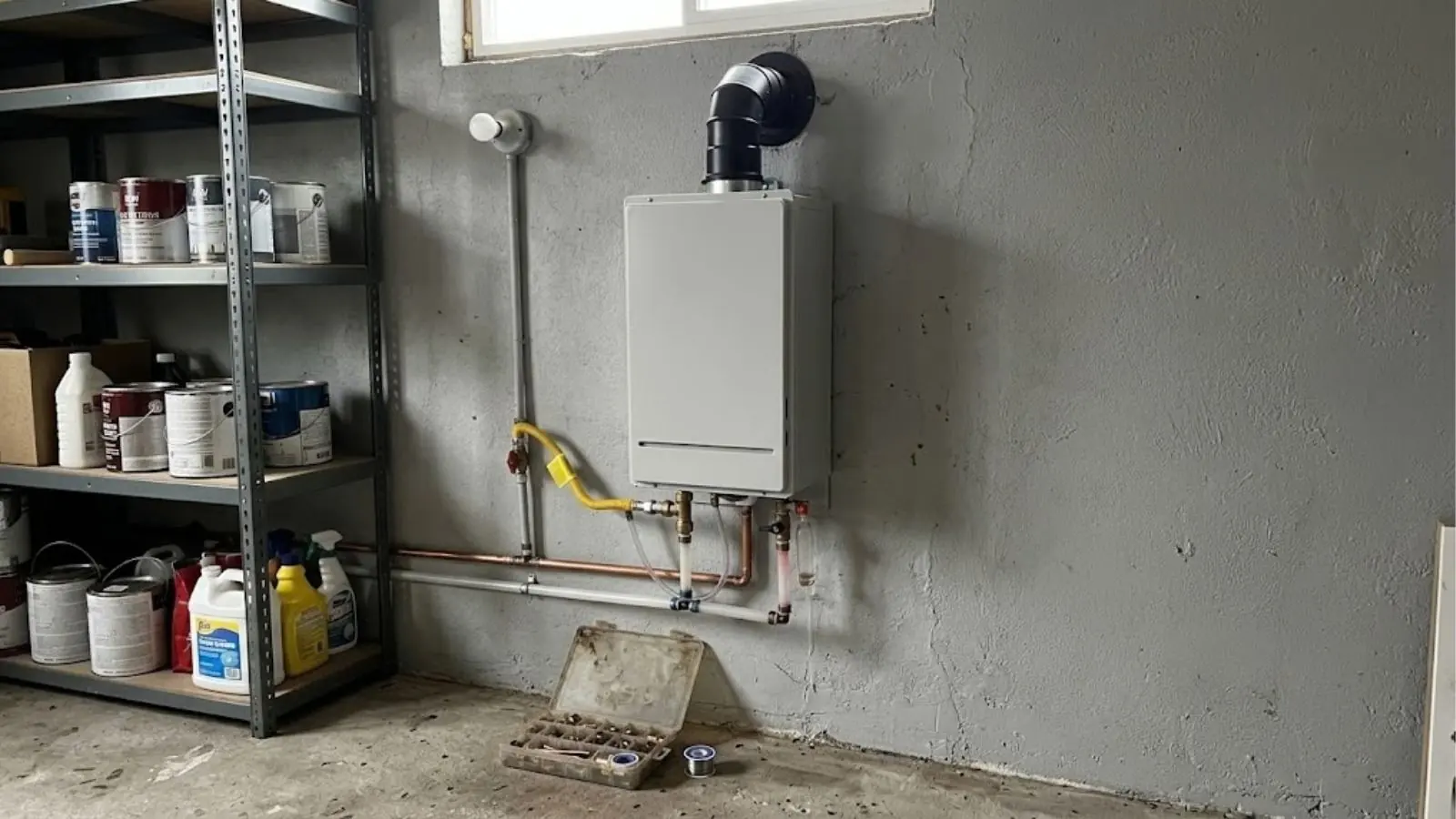
A tankless water heater heats water only when you open a tap. There is no tank to fail and leak, and the unit mounts on a wall. The trade-off is that the unit has to deliver a lot of heat quickly, so it needs a bigger gas line or a heavier electrical supply than a tank, and it needs correct venting.
If your tankless unit has stopped working, call our 24/7 line and mention the error code on its display.
Is tankless right for your home?
| Factor | Tankless | Tank |
|---|---|---|
| Hot water supply | Continuous, within the unit's flow limit | Limited to the tank size, then recovery time |
| Space | Wall mount, small footprint | Needs floor space |
| Gas or electrical needs | Larger gas line or high amperage | Standard |
| Venting | Special sealed or stainless venting for gas | Standard vent for gas |
| Maintenance | Regular flushing | Occasional draining |
| Failure mode | Error codes, ignition, flow faults | Leaks from corrosion |
A household that runs two showers and a dishwasher at once may need a larger unit or two. A single person with one bathroom may do well with a small one. We ask about fixtures and usage, then size the unit to the peak, not the average. If the existing gas line is undersized, we explain what upgrading it involves, and the cost goes into the quote before work starts.
Tankless flush and descale
Flushing a tankless heater means circulating a descaling solution, usually a mild acid such as vinegar or a manufacturer-approved product, through the heat exchanger and then rinsing. It removes mineral scale that slows heat transfer and triggers error codes. Manufacturers publish a recommended interval, and many units have service valves to make flushing simple. If yours does not, a plumber can add them.
Kirkland's water is very soft, with the City reporting total hardness of 1.43 grains per gallon, so scale builds more slowly here than in hard-water regions. That does not make flushing optional. Sediment, and mineral from other sources, still collect over time, and manufacturers usually require flushing to keep a warranty valid. Check your unit's manual for the schedule.
Signs a tankless unit needs attention
- An error code on the display, which a plumber can look up for your model.
- Water that fluctuates between hot and cold at a steady flow.
- A rumbling, whistling or tapping sound from the unit.
- Lukewarm water even at a full flow rate.
- Reduced flow, which can mean a clogged inlet filter or scale.
- A burning or exhaust smell near the unit. Shut off gas and call.
Installation: what the job really involves
Gas tankless units need a gas line of the right size, a vent that carries hot exhaust outside, and a way to drain condensation from high-efficiency models. Electric units need heavy circuits that may require a panel upgrade.
Both need isolation valves for flushing, a relief valve and, in some homes, a recirculation line. Gas piping and water heater work require permits in Kirkland, per the regional permit table, and a licensed plumber handles that step.
Where the unit goes matters. A wall near an exterior outside wall makes venting simple. A mid-house closet may need long vent runs, and each elbow reduces what the unit can deliver. Plan with your plumber before buying a unit online, because the wrong model for the home is an expensive lesson.
Repairs and common faults
Most tankless faults come from scale, a dirty inlet screen, a failed sensor, or a venting or ignition problem. An error code points to the area. A technician who knows your model can usually tell from the code whether the repair is a flush, a part, or something larger. For a tank unit that has failed, see water heater repair or replacement.
Pricing factors
- Unit size, fuel and efficiency level.
- Gas line upgrade, vent run and electrical work.
- Location in the house.
- Permit and inspection.
- For a flush, whether service valves are present.
You get a clear price before work starts. Gas safety comes first, so if you smell gas, leave and call Puget Sound Energy at 1-888-225-5773. To discuss your home, call us.
What to do while you wait for service
- Turn off the water to the unit if it is leaking, and use the isolation valves if it has them.
- Switch off the power at the breaker for an electric unit.
- If you smell gas, leave the building and call 911 or Puget Sound Energy at 1-888-225-5773.
- Photograph the display and write down any error code.
- Do not remove the cover or relight the unit yourself.
Gas tankless installs involve venting and gas sizing under the plumbing and mechanical codes, and electrical connections follow the National Electrical Code (NEC) as adopted in Washington. A plumber should confirm all three before sizing a unit.
Tankless water heater questions
Follow the manufacturer's schedule, which is often once a year. A plumber can advise based on your model and water.
No. Kirkland water is very soft, so scale builds slowly, but manufacturers still require periodic flushing, and sediment collects regardless.
Often yes, but gas line size, venting and electrical capacity decide. We check all of them first.
It depends on your model. Many point to ignition, flow, venting or temperature sensor faults. Tell us the code when you call.
Not in the tank sense, but they have a flow limit. Too many fixtures at once can exceed it.
Water heater replacement and gas piping are on the permit-required list. We handle the permit.