
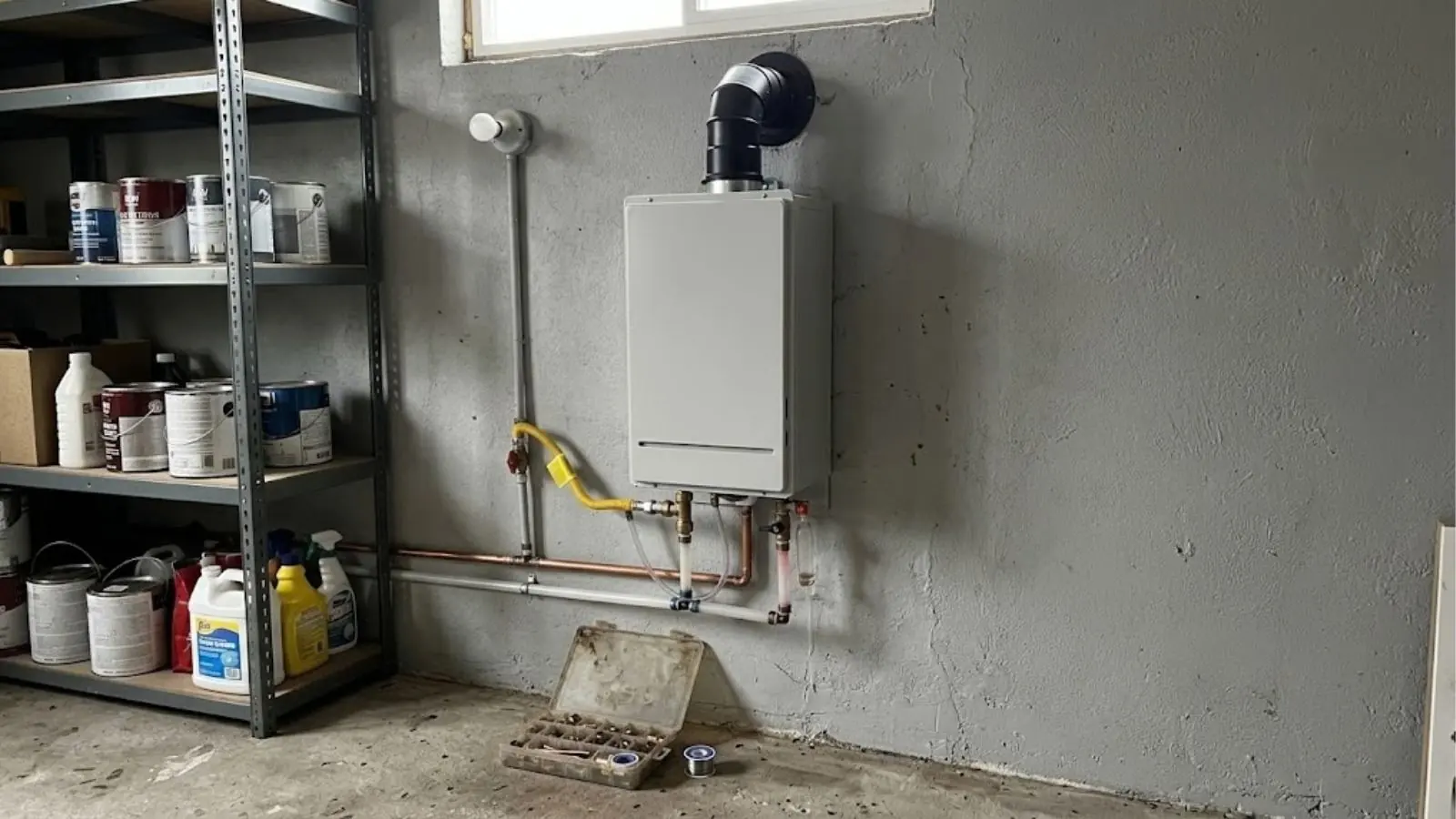
Resetting a tankless water heater means turning the unit off, waiting, and turning it on again so the controller restarts. It clears temporary glitches such as a tripped safety or a confused sensor. If the unit comes back and works, you can note the error and watch it. If the same error returns, the problem is a physical one, and the reset is only a pause.
A safe reset sequence
Note the error
Photograph the display and write down the code before you do anything.
Power off
Turn the unit off with its power button, and switch off the power at the outlet or breaker.
Wait
Wait at least a few minutes so the controller fully clears.
Restart
Restore power, turn the unit on and open a hot tap to see if it fires.
Check your manual for the exact reset procedure, since models differ. Some have a reset button, and some need the gas valve cycled. Gas units should have the gas supply left on or cycled only as the manual says. If you smell gas at any point, leave and call Puget Sound Energy at 1-888-225-5773 or 911 from outside.
What a reset will and will not fix
| Fault | Reset helps? | What actually fixes it |
|---|---|---|
| Brief power glitch | Yes | Nothing more needed |
| Flow error from a low-flow tap | Sometimes | Open the tap further |
| Scale buildup in the heat exchanger | No | Flush and descale |
| Clogged inlet filter | No | Clean the filter |
| Ignition or flame sensor fault | Sometimes | Technician service |
| Venting blockage or fan fault | No | Technician service |
| No gas supply | No | Check gas supply and valve |
Before and after the reset: quick checks
Items to confirm
- The cold water isolation valve is fully open.
- The hot water isolation valve is fully open.
- The gas supply is on, for gas units, and the electrical supply is on.
- There are no obstructions near the vent terminal outside.
- The inlet filter screen is clean, with the water off and the manual's steps followed.
- The display shows a normal status after restart.
When resetting becomes a habit
If you have to reset the heater every few weeks, something is wrong. Scale, a failing sensor or a venting issue often hides behind a recurring error. A technician can flush the unit, test the sensors and check venting. Our tankless water heater page explains the flush and the repair visit, and our water heater repair page covers tank units, in case your system is a mix.
If the unit does not restart at all, check for a tripped breaker, a closed gas valve and the display. When none of that explains it, call. Our 24/7 line is open, and the plumber will ask for your model and error code.
Do not bypass safety features
Tankless units have safeties that shut them down when something is wrong, such as overheating, blocked venting or flame failure. Do not jumper or disable them. A unit that keeps tripping is telling you about a hazard, and the right response is service. A plumber can test the safeties and the combustion if it is a gas unit.
Reading the display and keeping notes
Every tankless model has a code list in its manual or on the manufacturer's website. Keep a short log of each error with the date, what you were doing and whether a reset cleared it. A pattern shows up quickly.
A flow error that appears only when two showers run points to sizing. An ignition error that appears on cold mornings may point to a venting or supply issue. A technician finds that log very useful.
Some units connect to an app or a remote controller that shows the same codes and a history. If yours does, take a screenshot before you reset. A reset can clear the history on some models, and you want the record for the service visit.
Power outages, surges and resets
A power blip is a common reason a unit stops. Gas tankless heaters still need electricity for the controller, fan and igniter. After an outage, a reset is normal. If the unit repeatedly drops out during storms, a surge protector made for appliances is a modest precaution, and an electrician can advise on the circuit. A unit that faults when the power is steady needs service, and our tankless service page explains the visit.
Resetting a unit is an owner-level step, but opening one for repair involves gas, venting and electrical connections covered by the Uniform Plumbing Code (UPC) and the National Electrical Code (NEC) as adopted in Washington. Leave that to a licensed plumber.
Kirkland note: water and permits
The City of Kirkland reports that its water, from Seattle Public Utilities through the Cascade Water Alliance, has total hardness of 1.43 grains per gallon. That is soft, so scale is slower than in hard-water regions, but flushing is still on the manufacturer's schedule. Debris from nearby pipe work can still clog an inlet filter.
Gas piping and water heater replacement are on the permit-required list for Kirkland in the regional permit table, so any repair that changes the gas line should be handled by a plumber with the permit. In Redmond, see our Redmond page.
Tankless reset questions
A few minutes is usual, but follow the manual for your model.
A normal reset does not. Opening sealed parts or bypassing safeties can.
The controller may lose its settings or trip a safety. A reset usually restores it.
The error is physical. Flush, check the inlet filter and call for service.
Yes, if you follow the manual. If you smell gas, leave and call PSE or 911.