
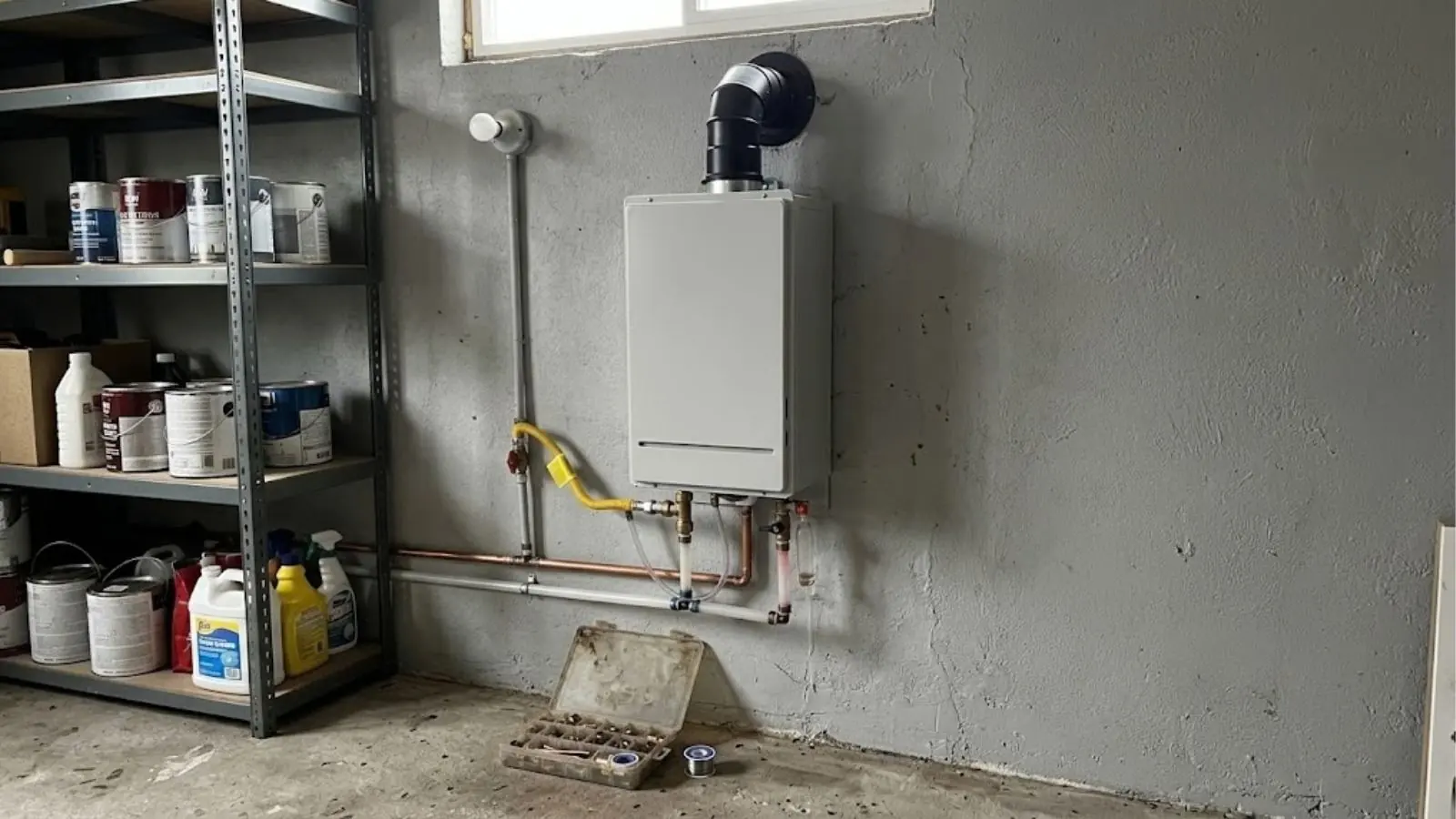
A tankless water heater does not heat until water flows through it. A flow sensor, often a small turbine or paddle inside the unit, tells the controller how much water is moving. If the sensor reads too little, the burner or elements do not start.
If it reads wrong, the unit may shut down in the middle of a shower or flash an error. Most flow sensor problems come down to debris, scale or low flow at the fixture.
What the flow sensor does
The sensor counts how fast water passes through the unit. The control board uses that number to decide when to fire and how much heat to deliver. Most units need a minimum flow to ignite, which varies by model. That is why a barely open tap can leave you with cold water, and why a partly clogged aerator can look like a heater failure.
Signs the sensor or flow is the problem
- The heater will not fire when you open a tap slightly, but does when you open it wide.
- Hot water cuts out in the middle of a shower and returns after a minute.
- An error code about flow or water supply shows on the display.
- Water temperature swings with no change in the tap setting.
- Reduced flow from every hot water fixture, not just one.
What to check before calling
Safe checks a homeowner can do
- Open several hot taps and compare. If only one is weak, clean that aerator.
- Confirm the cold water isolation valve to the unit is fully open.
- Look at the inlet water filter screen if the unit has an accessible one, and clean it per the manual with the water shut off.
- Check for a closed or partly closed valve in the supply line.
- Note any error code and the model number, and photograph the display.
Do not open the sealed part of the unit, and do not bypass sensors. Gas units have combustion parts, and electrical models carry high amperage. If you smell gas, leave and call Puget Sound Energy at 1-888-225-5773 or 911.
Scale, sediment and the flow sensor
Mineral scale and sediment can foul the turbine or the heat exchanger and reduce flow. Flushing the unit with a descaling solution clears it, and many models have service valves to make that easy. If your unit has no service valves, a plumber can add them. See our tankless water heater page for flush details. Flushing is a regular task, and manufacturers typically ask for it at a set interval.
| Symptom | Likely cause | First step |
|---|---|---|
| No heat, low flow at one tap | Clogged aerator | Clean the aerator |
| No heat at any tap | Closed isolation valve or clogged inlet screen | Open the valve, clean the screen |
| Cold mid-shower | Flow dips below the minimum | Open the tap further, check the supply |
| Error code for flow | Sensor, debris or scale | Flush, then call if it returns |
| Hot and cold swings | Pressure changes or a failing sensor | Test pressure, then service |
When to call a plumber
If the checks do not fix it, or if the unit shows repeated error codes, call. A technician can test the sensor, flush the heat exchanger and check pressure and gas supply. If the unit is old and a part is no longer available, we say so plainly. For help, our 24/7 line takes calls any time, and our water heater repair page covers tank units too.
Sizing and flow in your home
A unit sized for one bathroom may struggle when two showers and a dishwasher run together. If a flow-related shutdown happens only at busy times, the unit may be undersized for the household. A plumber can compare the unit's maximum flow with your peak use and tell you honestly whether a second unit or a different size makes sense.
If you are not sure whether the problem is the heater or the house, run a simple comparison. Fill a bucket from a hot tap and time it, then do the same at the cold tap. A big gap suggests the hot side is restricted, which points to the unit, its filter or a valve between the unit and the house.
Gas tankless units follow venting and gas rules in the Uniform Plumbing Code (UPC) as adopted in Washington. A flow sensor that is replaced should match the manufacturer's part number for your model.
Kirkland note: your water supply and your tankless unit
The City of Kirkland reports very soft water, with total hardness of 1.43 grains per gallon, from Seattle Public Utilities through the Cascade Water Alliance, so scale builds slowly. Debris from pipe work and the pipes themselves can still clog a small inlet screen, so cleaning it is worth doing after any repair that shuts off the water.
Gas piping and water heater work are on the permit-required list for Kirkland in the regional permit table. If your flow problem leads to a gas line change, a plumber handles the permit. If you live in Redmond, see our Redmond service page.
Flow sensor questions
Most units need a minimum flow to fire. Below that, the sensor does not signal the heater to start.
Gas and high-voltage electric units have parts that should be handled by a licensed plumber. Cleaning an inlet screen is a safe homeowner task.
If cleaning the screen and flushing the unit do not help, a technician can test the sensor. A flush is the first step.
It slows scale, but sediment and debris still clog screens. Flush on the manufacturer's schedule.
Usually not, but a gas smell is. Leave the home and call Puget Sound Energy or 911.