
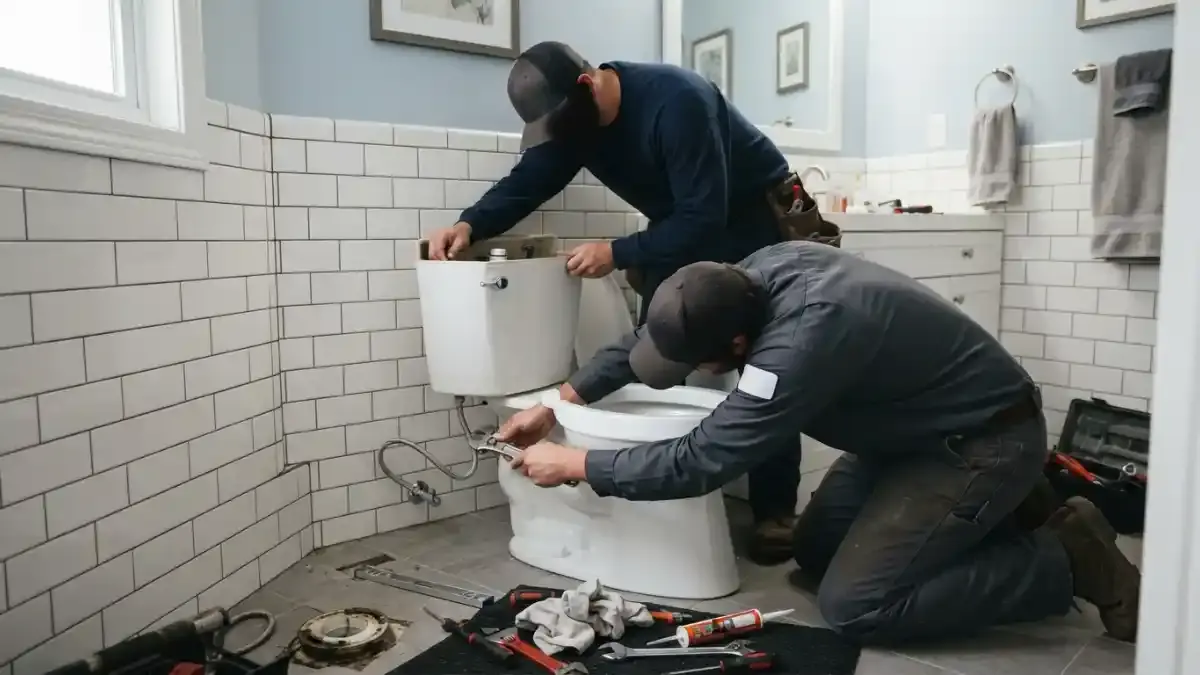
A cracked toilet tank leaks, and a crack in porcelain does not heal. Epoxy kits and sealants slow a hairline leak for a while, but they are stopgaps. If the crack is in the tank, the practical choice is usually replacing the tank or the whole toilet. If water is only appearing as beads on the outside, it may be condensation, which is a different problem and an easy one.
Crack or condensation?
Cold water in a tank cools the porcelain. On a warm, humid day, moisture forms on the outside and drips, and a rug under the toilet gets damp. A real crack shows as a line in the porcelain with water seeping along it, and the water level in the tank slowly drops.
Dry the tank with a towel, put a few drops of food coloring in the water, and watch. Color on the outside confirms a crack.
| What you see | Likely cause | Fix |
|---|---|---|
| Beads over the whole tank surface | Condensation | Insulated tank liner, better ventilation |
| A line of water from a visible crack | Cracked tank | Replace tank or toilet |
| Water at the tank bolts | Worn bolts and washers | Replace bolts and washers |
| Water at the supply connection | Loose or worn connector | Tighten or replace the supply line |
| Water at the base of the toilet | Failed seal | Reset the toilet with a new seal |
What to do while you wait
Steps to limit damage
- Turn the angle stop behind the toilet clockwise to shut off the supply.
- Flush once to empty the tank, then keep the valve closed until the repair.
- Dry the floor, and check the subfloor for soft spots.
- Photograph the crack for any warranty claim.
- Do not flush repeatedly, because the tank will refill and leak again.
Repair, replace the tank, or replace the toilet
A two-piece toilet has a separate tank, and a replacement tank may be available for some models. Matching the tank to the bowl, the bolt pattern and the finish can be difficult for older or discontinued models. Often, replacing the whole toilet costs little more than a matched tank, and it gives you a more efficient flush.
A plumber can look at the toilet and tell you which is worth it. See our toilet repair page for what a visit involves.
Bowl and base cracks
A crack in the bowl or the base is a bigger problem, since it can leak sewage water. Stop using the toilet and call. A crack near the base, especially after the toilet has been moved or bumped, usually means replacement. Do not try to patch it with caulk.
When it is not the tank at all
Many wet spots turn out to be a seal or a supply line. The flapper, fill valve and bolts are common culprits, and they are inexpensive to fix. If more than one fixture is leaking, or if the floor near the toilet is soft, call a plumber who can check the flange and the drain line, and if drains are slow, the drain cleaning page explains the next step.
Our 24/7 line is open if water is on the floor.
Why tanks crack in the first place
Porcelain is hard but brittle. A tank cracks when something stresses it unevenly: overtightened tank bolts, a lid dropped on the rim, a heavy object stored on top, or a house that has settled and put pressure on the toilet. Hot water poured into a very cold tank can also cause a hairline fracture. Knowing the cause helps you avoid a second crack in the replacement.
When you install a new tank or toilet, tighten the bolts evenly and only until snug. Rubber washers do the sealing, not the force of the nut. A quarter turn past hand tight on each side is usually enough, and a plumber will check that the toilet sits level so no corner carries the load.
Checking the floor and flange after a leak
A tank leak soaks the floor under and around the toilet. Before a new toilet goes in, check the subfloor for softness and the flange for rust or cracks. A weak flange lets the toilet rock, and the next seal fails. If the floor is soft, stop and get a carpenter or a plumber to look before water has the chance to cause rot. The earlier you catch it the smaller the repair.
A replacement toilet should meet the flush volume limits in the Uniform Plumbing Code (UPC) as adopted in Washington. Check the rating on the bowl or tank label before you buy.
Kirkland note: permits for a toilet swap
The regional permit table lists bathroom and kitchen fixture replacements without plumbing line modifications, such as sinks and toilets, among the work that does not require a permit. That is a general statement for the jurisdictions the guide covers, so check with the City of Kirkland building department if your project involves changing pipes or moving the toilet. The City's plumbing permit line is (425) 587-3600.
Many homes in Juanita, Finn Hill and Kingsgate were built in the mid-century through the 1980s, and an older toilet may have a corroded supply valve or flange. If you replace the toilet, replacing an old supply valve at the same visit is cheap insurance. If you live in Redmond, see our Redmond page.
Cracked toilet tank questions
It may slow a hairline leak for a while, but it is a stopgap. Replacement is the lasting fix.
Dry the tank, add food coloring and watch for colored water on the outside. A line of seepage along a crack confirms it.
Regional guidance lists simple fixture replacements as not needing a permit, but ask the City if your project changes pipes.
Cold water in the tank causes condensation in humid weather. Better ventilation or a liner helps.
Often yes, because matching a tank to an older bowl is hard and the cost is close.